

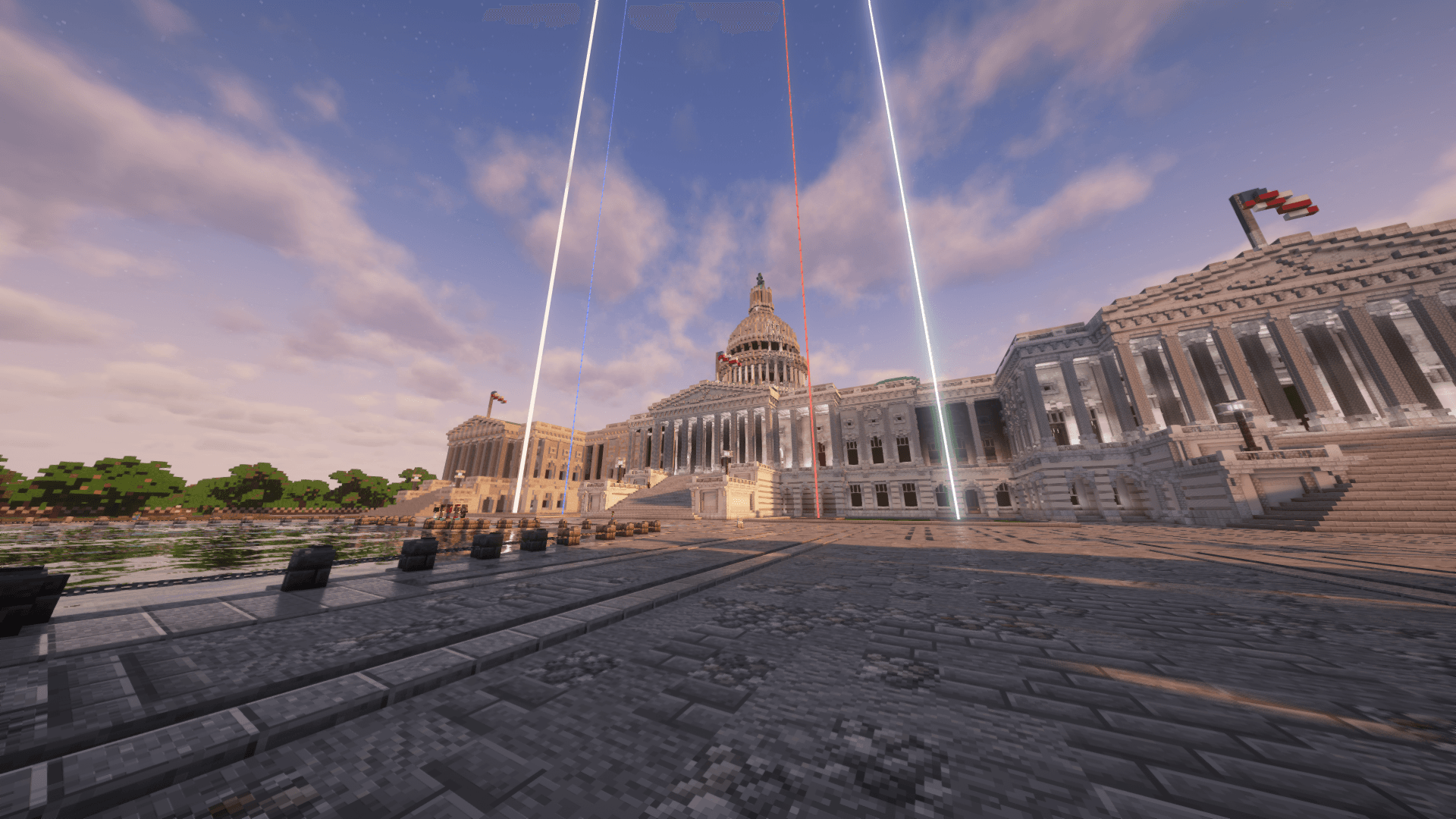

Welcome to the very first Historia Highlight!
Each Friday over the next few months, we'll be delivering news about the server's upcoming features right here. Some posts will cover major updates, others smaller additions, and some will simply showcase the server.
Today, we have our first in-depth look at Governments, quite possibly the largest requested feature across the geopol genre.
Governments Across Geopols
One thing that has always irked me while playing on almost any other geopol server is that governments don't physically exist. Yes, you can always roleplay the United States with a senate, a house, a presidency... but none of it is enforceable. At any time, the president can just sorta.. quit. Or decide they don't want to be a democracy anymore. Sure, that could be "realistic," but it isn't very fair and just generally feels bad.
Some servers take the route of trying to implement something. So what they do is they add various types of governments that you can pick from. Each government has its own benefits, its own drawbacks, etc.
However, this is very game-y. And remember, governments are very complicated entities. In real life, we endlessly debate over government systems because we don't have a 100% answer to what will always work. Trying to simplify that into a bunch of arbitrary bonuses and modifiers makes the system not feel quite right. When working on governments, I actually took this approach first. I very quickly found out that it just doesn't work that well during playtesting. So, how do we make a system that actually, physically emulates governments?
The Structure of Governments
Instead of giving you a handful of boring government types that you can choose from, you will be able to create your OWN governments. Everything is customizable here.
Give your government a custom name. Add as many legislatures as you want. Create as many offices as you want with custom abilities that hook back into actual permissions. You decide what structures exist, who is part of those structures, and what authorities those people have. The system is designed so that there are no easy workarounds or bypasses unless you specifically want them in your government. The president can't disband the nation unless you want them to have that power.
The architecture behind the government system is what I like to call the OPP structure (because it is over-power-powered, that's why!). The structure consists of three main parts: (O)ffices, (P)rocedures, (P)olicies.
Offices
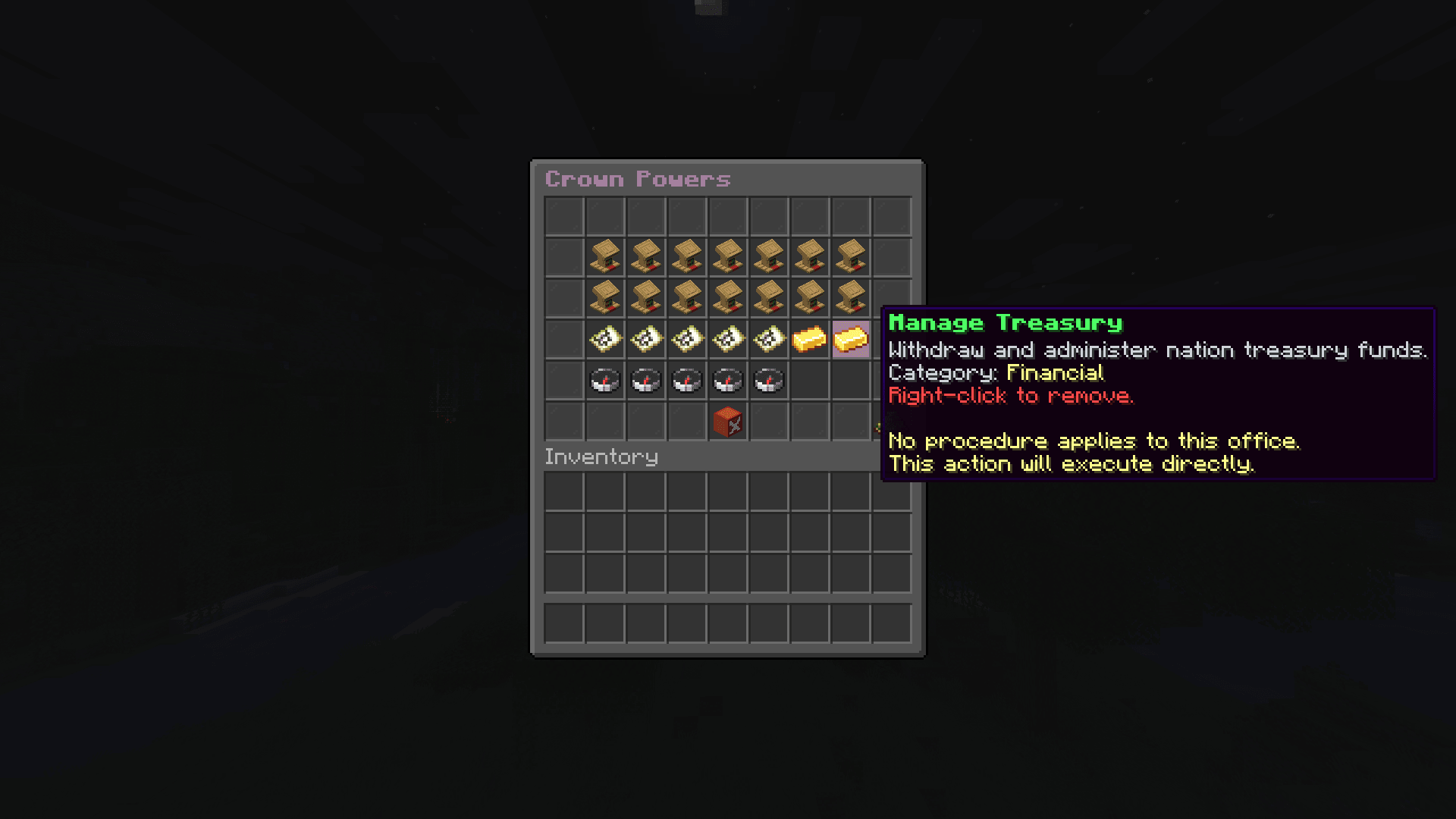
- These are the actual legal entities that exist inside your government. They are composed of three configurable parts: Holders, Powers, and Provisions.
- Holders are who occupy the office. Depending on how the rest of the government is configured, they may be elected, appointed, impeached, etc. An office can have as many holders as you would like.
- Powers are the permissions that get granted to Holders of that office. There are many Powers: ones for diplomacy, to manage the treasury, to change the nation's identity, to amend the government. The list is very large, and you can mix and match as you wish.
- Provisions are the constitutional structures of the office. They answer basic operating questions like: Is this office elected? Are there term limits? Do holders have a salary? and more.
Procedures
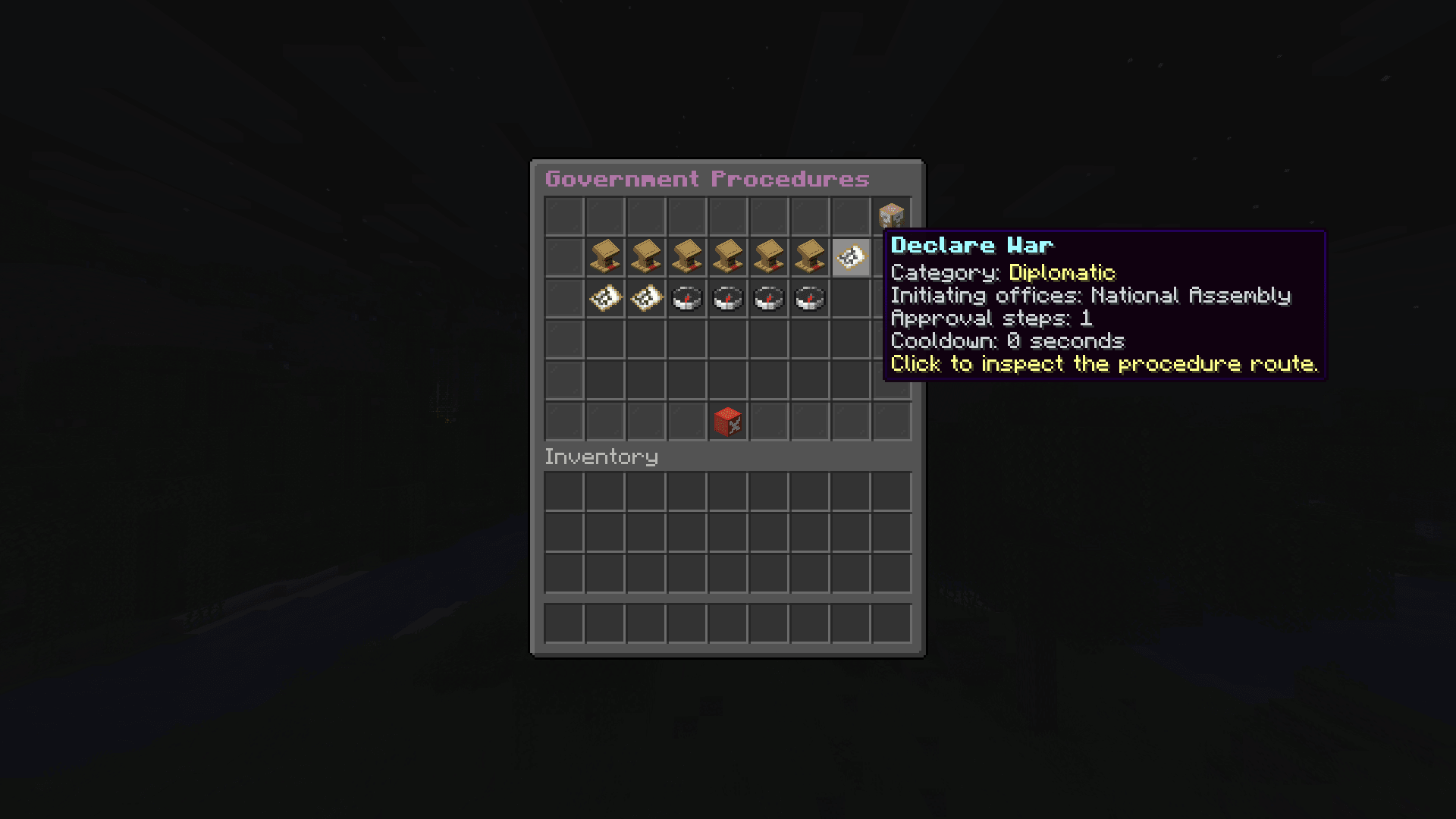
- These map office powers through various approval stages. It is a node-based system that can also be mixed and matched.
- Every government office power has a behind-the-scenes Government Action. For each of these actions, they can be mapped to an approval stage. An office may have the power to initiate the action by the power vested in them, but if a procedure exists for that action mapped to their office, then they will need approval.
- This is how you make legislatures. Say you have a council of 5 that wants to make a change to the tax rate. Since the office has a power allowing its holders to make that change, a holder can initiate the government action. The government action follows the procedure pipeline established. It sees that first it needs a simple majority from the council. The council approves it. The action continues to the King, who asks for their approval. The king approves it and it is made as a change. Or, the king vetoes it. If there is a procedure for a veto mapping, then potentially the council could also overrule the king's veto. This is just one of almost infinite examples.
Policies
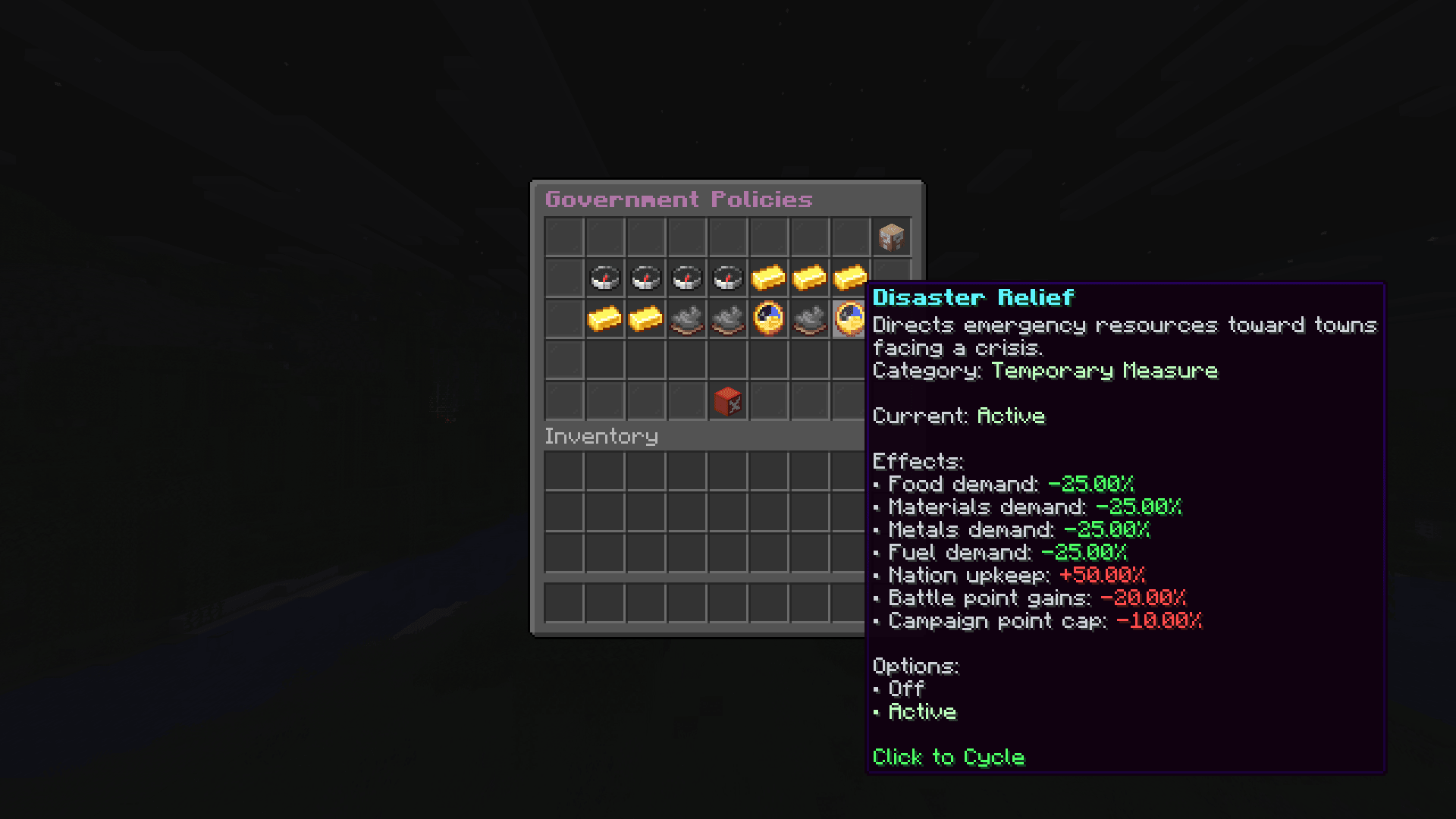
- These are the physical levers of your nation. They are essentially the context surrounding your nation. There are 3 types of policies: Constitutional, Spending, and Temporary.
- Constitutional policies are a question of what your nation as a whole can or can't do. For instance, it may say that the nation is not allowed to kick member towns. It may say that the nation cannot be aggressive in its wars. Or perhaps you want to run an oppressive regime that threatens its town with hostile retaliation if they leave the nation. Up to you.
- Spending policies range from "Very Low" to "Very High". They cover different aspects of your nation's budget. Your nation may choose to invest heavily in its military, or in its agriculture. Doing so, you enact real bonuses (or penalties if you choose to not spend as much) for your people to enjoy. However, these come at hefty upkeep costs, so unless you have the wealth to support it, spend wisely.
- Temporary policies are extraordinary measures you can enact in a dire set of circumstances. Once enabled, they apply a set of large bonuses for your nation. However, you will need to use these sparingly, as they also apply a set of large penalties and will go on cooldown after. For instance, if you are fighting a losing war, you may consider enacting Desperate Measures. This will give you huge bonuses in war. In exchange, your economy will suffer. Your towns will struggle to keep the weight of the war machine alive. Some mayors would think twice about being loyal to a nation draining them of their resources and coffers.
Here is the full list of policies.
| Policy | Type | Description |
|---|---|---|
| Peaceful Departure | Constitutional | Defines whether a departing town creates a reunification wargoal |
| Town Expulsion | Constitutional | Defines whether the nation may expel a member town |
| Town Censure | Constitutional | Defines whether the nation may censure a member town, restricting their influence in government |
| Foreign Affairs | Constitutional | Defines which foreign commitments and hostilities the nation may initiate |
| Military Spending | Spending | Funds battlefield readiness at the cost of national upkeep and supplies |
| Fortification Spending | Spending | Funds defensive works at the cost of national upkeep and supplies |
| Public Infrastructure Spending | Spending | Funds development at the cost of town and national upkeep |
| Agricultural Spending | Spending | Funds agricultural production at the cost of national upkeep |
| Industrial Spending | Spending | Funds industrial production at the cost of national upkeep |
| Desperate Measures | Temporary | A last-stand defensive response that requires an active, losing war |
| Total War Economy | Temporary | Reorients the economy toward an active war |
| Economic Austerity | Temporary | Reduces national costs while accepting broad domestic sacrifices |
| National Reconstruction | Temporary | Accelerates recovery after a recently ended war |
| Disaster Relief | Temporary | Directs emergency resources towards towns facing a crisis. |
Amending Governments
This system has been extensively playtested. In order to facilitate mass government edits without having to constantly make a change, wait for approval, just to make another change, you can toggle on "Amend Mode" in the GUI. Anything about the government that you have the power to amend, you can amend all in one pass. Then, once done, you submit the amendment, and the government action follows the appropriate pipeline.
All of this is done via GUIs. No commands needed. There are commands, if you still really want to use them though.
Votes and Elections
This government system also comes with a built-in voting and election system, so you don't have to worry about all the complexities of trying to fumble with Google Forms and then tell the server what the results are.
Votes
Every time a government action needs to follow a procedure pipeline, a vote is created for eligible voters. Depending on the procedure's specifications, it may require a simple majority (51%), two-thirds (67%), or unanimity (100%).
Votes also have quorums. This is the minimum percentage of eligible voters needed to determine an outcome. You may abstain from a vote, withholding your vote while still counting toward the quorum. Votes can also have set voting windows.
Elections
Elections are based on an office's provisions. Given the values it is granted, the server will automatically schedule elections for holders of that office. Like votes, elections also include provisions for who may nominate players, who may vote for them, voting windows, and more.
Looking Ahead
Governments are the foundation of a much larger interconnected network of systems on Historia. They hook into almost anything, from war and diplomacy and are represented visually almost everywhere. They are the core identity of the nations they apply to.
I think you all will appreciate this feature, and I am very curious to see what you all will do with it. Next week we'll be taking a look at the custom War System.
Feel free to discuss in Discord in general, or leave suggestions.