



Hello Historians,
Today, we're taking a look at diplomacy: treaties, alliances, economic partnerships, calls to arms, and the other ways nations can interact without immediately going to war.
I already covered the War System in HH#3, including how wars begin and how they end. This time, we're looking at everything around them: the agreements nations make, what those agreements actually mean, and what happens when a government decides it no longer wants to honor one.
Towny Alliances
On most Towny servers, alliances are pretty simple. One nation sends a request, the other accepts it, and you can now magically teleport to their nation, fight in their war, really anything. What that alliance actually means is usually left entirely to roleplay. Does your ally have to defend you? Can you call them into an offensive war? Are you trading partners, or is the alliance purely militaristic? Can either nation just leave whenever it wants, even right before a war?
Usually, the server itself has no answer. Players can write out a detailed treaty in Discord, but as far as the game is concerned, the two nations just clicked the "ally" button. If the written agreement and the actual mechanics disagree, staff are left sorting through screenshots and arguments about what everyone supposedly agreed to.
We're going to do that a bit differently here. Nations don't form alliances directly, and are instead going to sign real treaties, and those treaties should determine what their relationship actually means.
Treaties
There are currently four treaty types:
- Non-Aggression Pact: Prevents the two nations from taking hostile diplomatic or war actions against one another
- Economic Partnership: Allows nations to send treasury aid and can provide access to international trade
- Mutual Defense Treaty: Creates a military alliance and requires each nation to answer defensive calls to arms
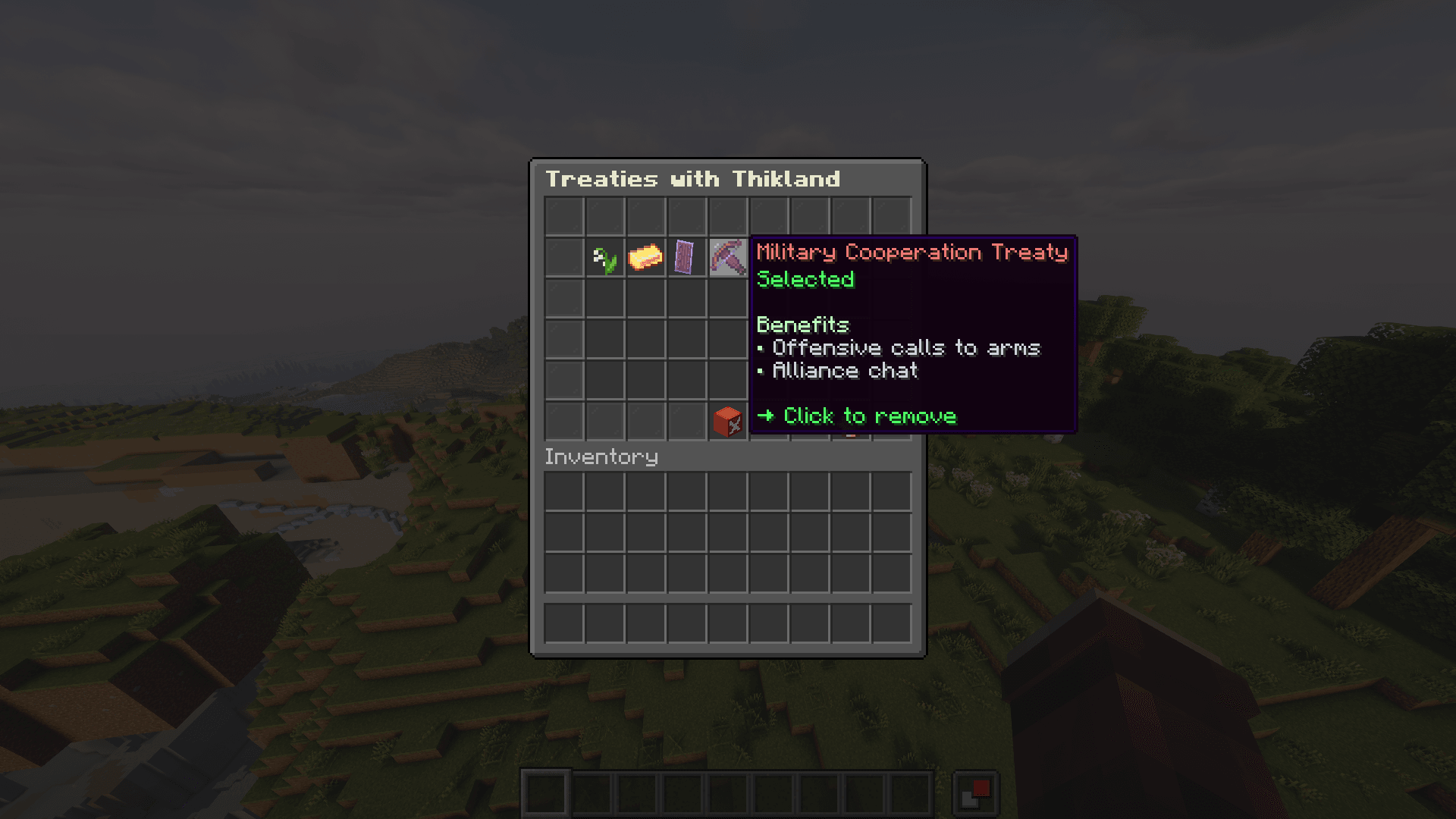
- Military Cooperation Treaty: Creates a military alliance and allows nations to call one another into offensive wars
These are all separate agreements. Two nations can have an Economic Partnership without promising to fight for one another. They can combine trade with a Non-Aggression Pact while still remaining politically independent. Nations that want a much closer relationship can sign several treaties with the same partner.
That's intentional. "Friendly" doesn't really tell you much about a country's foreign policy. Two nations might trust each other enough to trade, but not enough to fight together. They might agree to defend one another without supporting each other's offensive wars. Or they might just want to guarantee that neither side is going to attack the other for a while.
The simplest treaty is the Non-Aggression Pact. It doesn't make the two nations allies, and neither side is required to help the other with trade, wars, etc. It does one thing, which is to guarantee peace between them while the treaty is active. Neither nation can mark the other as an enemy, prepare hostile action against it, or accept a call to arms that would put them on opposite sides of a war.
If relations start falling apart, one government has to formally withdraw first. Under the current settings, that withdrawal takes 48 hours. The treaty remains active during that period, so a nation can't reassure its neighbor one minute and invade it the next. That gives the other side time to see what's happening and prepare. It also creates room for politics before a war actually begins. While yes, it is realistic for nations to be able to stab each other in the back, we intend to create a fun experience that is fair for everyone regardless of factors like their time zone, so this is the best approach.
Economic Partnerships allow one nation to send money directly from its treasury to another. Like other national decisions, that aid can also go through the sending nation's government. Additionally, they will also grant you the ability to trade with that nation's chest shops.
The other two military focused treaties are more relevant to actual warfare. They mostly decide if you are allowed to ask that nation to join your war or not, or if they are obligated to fight in your war or not. Both treaties allow you to issue a call to arms to that other nation, to which they are given the option of accepting or refusing. If accepted, they will be added to your side of the war (assuming they are not also allied with the other side).
Vassalage
Unlike treaties between equal nations, vassalage connects an overlord and subject through a set of terms. Those terms can determine things like daily tribute, whether the subject has to join defensive wars or all wars, whether the overlord is required to defend the subject, and how long the relationship must last before it can be ended. After an overlord has subjugated another nation, likely through warfare as discussed in HH#3, their defined terms will take effect. The overlord will begin to collect tribute, and can force their subject's diplomacy at will, forcing them to fight in their wars.
And it doesn't necessarily have to end with another war. Once the minimum term has been completed, the overlord can voluntarily release the subject. The subject government can also formally request independence, which the overlord can approve or reject through its own government. Of course, if those methods don't resolve peacefully, then an independence war is always an option.
With that, it practically concludes most of TownyCivic's big features. I have a few more stuff saved that I am sure you will all appreciate, but you'll just have to experience it yourself.
Thank you all for stopping by for this Highlight. I've been really busy as of late, which is why I wasn't able to get it out last week. We're still keeping it on schedule though, so we'll have one next week, which ThikKrab will write!
Feel free to talk about it in the discussion below, or you can stop by our Discord.